


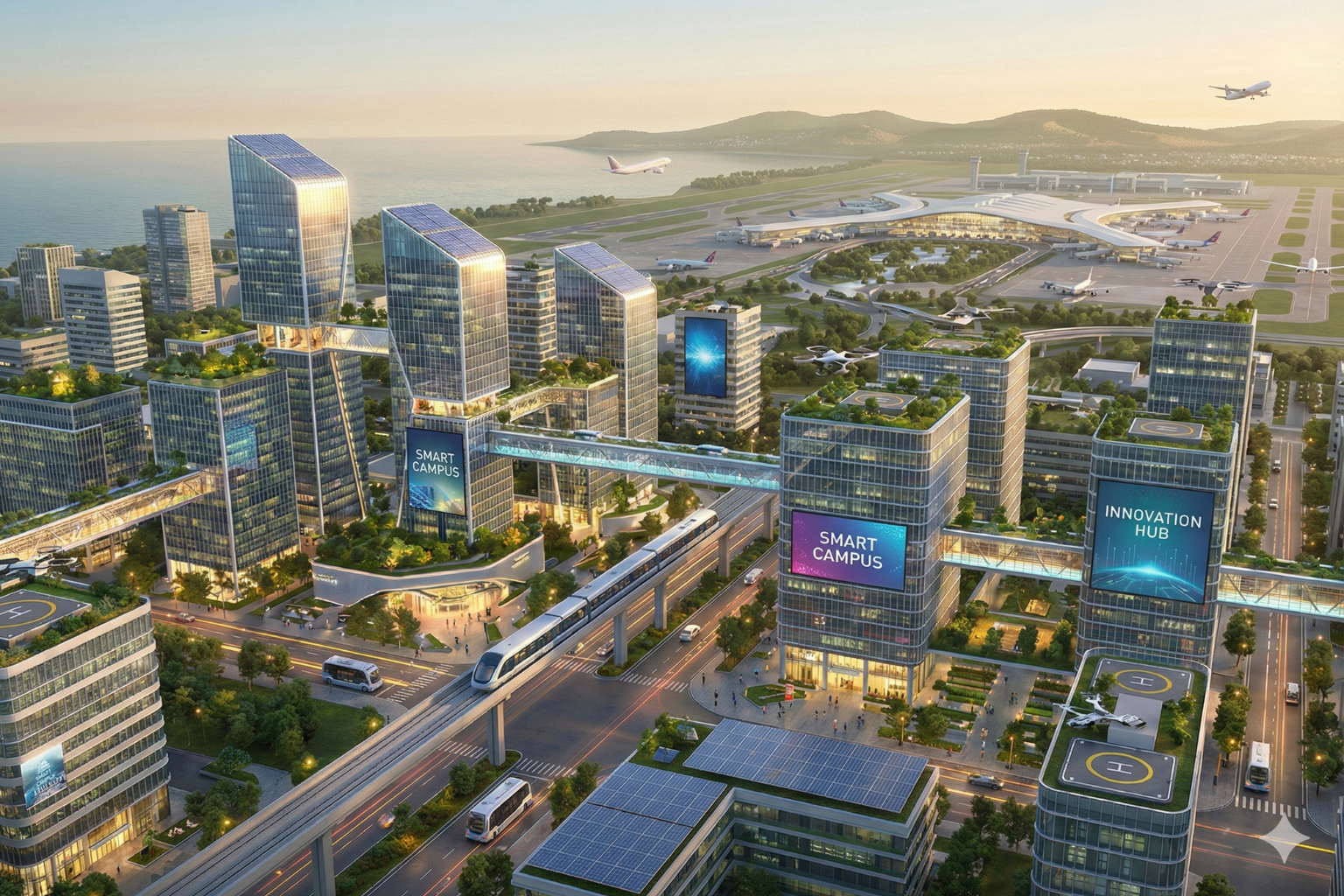
Why Mumbai 3.O Is Entering a New Growth Phase in 2026
The narrative around the Raigad corridor is rapidly evolving—from “far-off villages” to “India’s Next Data & Logistics Capital.”
Here’s what’s driving that shift:
-
Scale of Ambition: The notified area covers 323.44 sq. km, which is roughly three times the size of the original island city of Mumbai.
-
Institutional Shift: The government has officially appointed MMRDA (not CIDCO) as the planning authority, signaling a shift toward high-speed, integrated development similar to BKC.
-
The “Third City” Mandate: This isn’t just a suburb; it is designed to be a self-sustaining city with its own Edu City (attracting global universities) and Medi City.
This isn’t just hype—the fundamentals are shifting. The “paper city” is becoming concrete reality as surveys and master planning target an August 2026 completion.
Game-Changing Infrastructure Projects Near Mumbai 3.O
Let’s break down the three key engines transforming KSC New Town from the ground up:
1. Mumbai Trans Harbour Link (MTHL / Atal Setu)
-
What’s Happening: The 21.8 km sea bridge is fully operational, slashing travel time from South Mumbai to Chirle/Raigad from 2 hours to just 20 minutes.
-
Impact: This bridge has effectively merged the geography of South Mumbai’s elite business districts with Raigad’s affordable land.
-
Real Estate Translation: Access to affordable luxury is now a 20-minute drive away.
2. Navi Mumbai International Airport (NMIA)
-
Launch Timeline: It begins on 25 December 2025.
-
Projected Footfall: Starting with 20 million passengers, scaling to 90 million by 2032.
-
Ripple Effect: This anchors an “Aerotropolis” economy, driving demand for hotels, logistics parks, and rental housing in nodes like Panvel and Ulwe.
3. Virar-Alibaug Multimodal Corridor
-
What’s Happening: A 126 km expressway creating a “Ring Road” around the MMR.
-
Impact: It connects the manufacturing hubs of Virar with the logistics hubs of Alibaug, bypassing Mumbai’s congestion entirely.
-
Real Estate Translation: Industrial and warehousing demand will skyrocket along this belt, creating jobs and housing demand.
What This Means for Property Prices & Investment Strategy
Market Snapshot (2025)
-
Land/Plot Prices: Currently trading between ₹3,000 – ₹15,000/sq. ft., depending on proximity to MTHL landing points.
-
Comparison: South Mumbai prices exceed ₹50,000/sq. ft., creating a massive arbitrage opportunity.
-
Growth Projection: Analysts predict a 15-25% annual appreciation in well-connected nodes over the next 3-5 years.
Top Investment Nodes
-
Chirle & Ulwe: The immediate beneficiaries of the MTHL landing point.
-
Panvel Periphery: The gateway to the new airport and the rail corridors.
-
Pen & Uran: Emerging zones for long-term land banking.
Investment Strategies Based on Buyer Persona
First-Time Homebuyers
-
Budget: Look for project in the Panvel-Uran belt where developers are offering modern amenities at entry-level prices.
-
Timeline: Align your move-in date with the airport’s full operational stability (2026-27).
-
Tip: Verify RERA registration strictly, as many smaller players are launching “pre-launch” offers.
Investors
-
Strategy: “Follow the Master Plan.” The DP (Development Plan) is expected by August 2026. Buying land before zoning is finalized carries risk but offers the highest reward (3x-5x potential).
-
Asset Class: Focus on plots or commercial SCOs (Shop-cum-Offices) near the Multimodal Corridor.
Real Estate Agents
-
Pitch: Don’t sell “Raigad”; sell “Mumbai 3.O.” Use the MTHL travel time data to overcome the “it’s too far” objection.
-
Vision: Remind clients that Navi Mumbai (Vashi) was once considered “too far” in the 1990s. This is the same opportunity, repeated.
Case Study (Hypothetical)
-
Buyer: An investor purchases a 2,000 sq. ft. plot in a village near Chirle at ₹4,000/sq. ft. (Total Investment: ₹80 Lakhs) in early 2025.
-
2026-2028 Projection: As the Master Plan freezes zoning and the airport sees full international flights, land rates in the area jump to ₹7,000/sq. ft.
-
Result: A capital appreciation of 75% in 3 years, outperforming almost any residential flat in Mumbai city.
Pros & Cons: The Trade-Offs of Mumbai 3.O
|
Advantages |
Risks / Trade-Offs |
|
Entry Price: Lowest in the MMR region for the infrastructure offered. |
“Paper City” Risk: Master Plan is still under finalization (due Aug 2026). |
|
Connectivity: World-class access via MTHL & Airport. |
Gestation Period: This is a 5-7 year hold, not a quick flip. |
|
Planned City: Smart infrastructure, not organic chaos. |
Land Conflicts: Local farmer protests over land acquisition models (60:40 split) are ongoing. |
Frequently Asked Questions
Q1: What is the official name of Mumbai 3.O?
It is officially designated as the Karnala-Sai-Chirner (KSC) New Town, managed by the MMRDA.
Q2: Is it safe to invest in “Guntha” plots right now?
Be very cautious. Since the Master Plan is pending (expected 2026), ensure the land has a clear title and isn’t under government reservation. Sticking to RERA-registered plotted developments is safer.
Q3: How does this differ from Navi Mumbai (CIDCO)?
Navi Mumbai was built by CIDCO. Mumbai 3.O is being planned by MMRDA, the same authority that runs Mumbai’s Metro and BKC. The focus here is higher on economic hubs (Data Centers, Edu City) rather than just housing.
Q4: When will the airport actually start?
Phase 1 opened in mid dec 2025, handling domestic flights initially.
Q5: Can I commute to South Mumbai daily?
Yes. With the Atal Setu (MTHL), the drive from Chirle to Sewri is roughly 20 minutes.